01 · GENERATIVE MODEL
Draft the revised notice
“We will notify you before this change takes effect…”
Output: notice draft + cited circular passages.
Week of 28 September 2026
Why enterprise AI may divide work between models that create and models that judge.
TypeSafe is an AI start-up co-founded by Diogo Almeida, a former OpenAI researcher whose work helped lay the foundations for ChatGPT, alongside Sasha Sheng and Erik Gafni. In September 2026, it opened early access to its first AI model, Jev.
Jev is designed to help software make quick decisions. For example, a business could use it to read a customer message and decide which team should handle it. Where ChatGPT might write the reply, Jev could help decide where the message goes. TypeSafe’s aim is to make these everyday decisions fast and cheap enough to automate at scale.
Both models received one request containing 27 short, structured questions in the same order, starting together.
Preview of TypeSafe’s demonstration: Jev returning typed answers in parallel while the generative model produces its response sequentially.
Watch the original recording on TypeSafeTime to answer the 27 questions
75× faster
Bars start at zero
Price to answer the same 27 questions
171× cheaper
Bars start at zero
This is a selected vendor comparison of a short, dense query that favours Jev’s parallel design. It shows what is possible for this task shape; it does not establish the same advantage for every workflow. TypeSafe says its larger 193.6× speed and 444.6× cost figures come from separate workflow evaluations and are at the high end of expected gains.
Use it for a recurring choice: which team, which category, or whether a condition is met. A generative model can make these choices too; Jev is designed to return them without generating a written response.
INPUT · CUSTOMER REQUEST
“I was charged twice.”
Allowed teams: billing, technical support, sales.
Jev selects a team
OUTPUT · SOFTWARE ACTION
Send to billing
A generative model can then draft a reply using the customer’s account details.
Illustrative probabilities. Model design
A new document or request arrives. A generative model prepares a response; Jev answers the repeated checking and routing questions. Software uses those answers to move the work forward.
BANKING EXAMPLE · ILLUSTRATIVE
01 · GENERATIVE MODEL
“We will notify you before this change takes effect…”
Output: notice draft + cited circular passages.
02 · JEV
Made-up outputs to explain the interface. Confidence is a model estimate, not verified accuracy.
03 · SOFTWARE + REVIEWER
Flag the 61% evidence check
The reviewer checks the cited passage before approving the notice.
The routing rule and approval remain outside Jev.
Jev checks the draft and selects the review team. Compliance still approves the notice.
72 support-routing, phishing and incident-severity cases.
Most correct
Fastest
Lowest cost
100 synthetic customer reviews, each repeated three times; five fields per review.
Most correct
Fastest
Lowest cost
A valid answer can still send the notice to the wrong team or miss an exception in the circular.
The output format is guaranteed; choosing the right option still depends on learned patterns and the wording of the question.
The notice draft reaches the wrong review team
Test routing on previously reviewed proposals.
Jev judges the information supplied to it. An omitted policy exception or source passage can change the correct answer.
A missing exception in the circular changes what the notice must say
Include the relevant passages; allow “unclear”.
It returns predefined choices, scores and probabilities rather than generating text to explain its reasoning.
The reviewer cannot tell why a source check failed from the choice alone
Show the cited passage and draft together for review.
TypeSafe’s “zero hallucinations” refers to valid output types, not error-free answers. Source and caveats
These boundaries suggest a division of labour: generative models create and explain; decision models handle defined judgments.
Jev offers a hosted API. Kev and Laya let teams run decision models themselves and train them on their own examples.
Use a hosted API to return choices, scores and yes/no decisions with probability estimates.
Run Qwen-based decision models on your own hardware, or train them on your team’s labelled examples.
Run decisions on your own machines, so requests can stay within your infrastructure. Fine-tune Laya on your examples to recognise your categories and criteria.
ALIBABA · QWEN
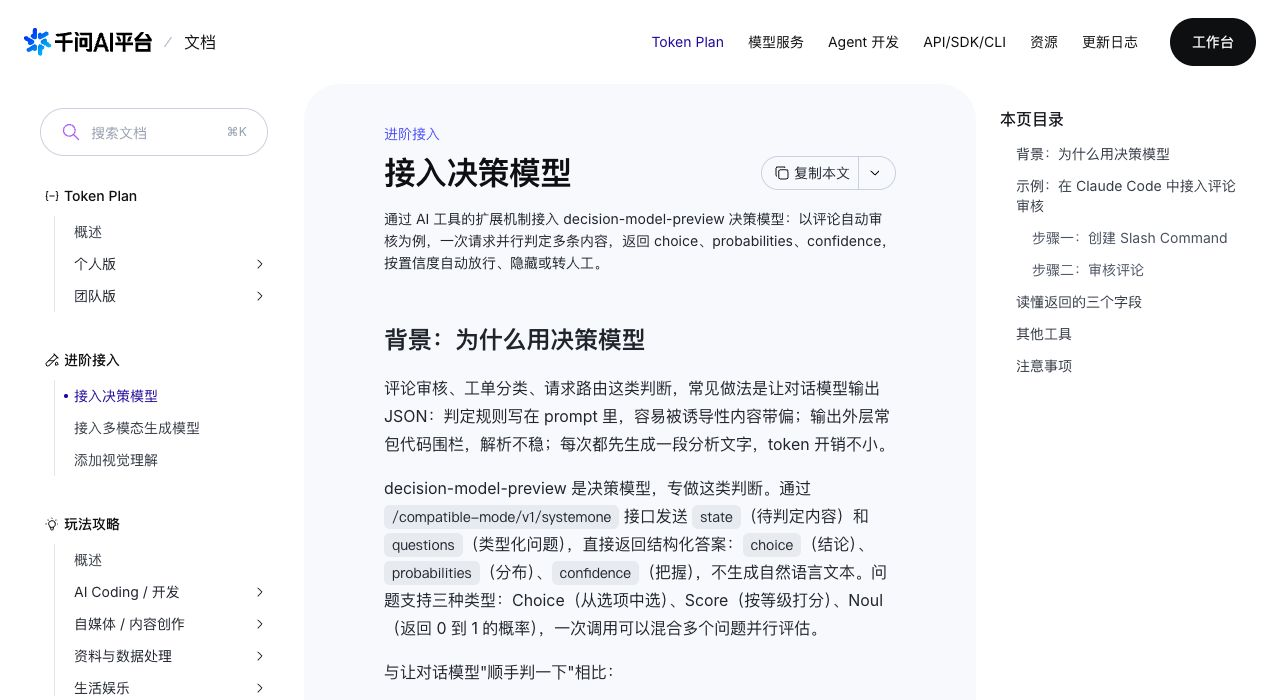
Qwen documents how a decision model can classify comments and route uncertain cases to a person.
Qwen’s documentationOPENAI · PRODUCT LEADERSHIP

Thibault “Tibo” Sottiaux leads core products at OpenAI, including ChatGPT and Codex.
Original X postPick one repeated choice. Compare the answers, waiting time and cost, then try it in your workflow.
Run the same checks on every new product description, against its terms and conditions.
Illustrative model probabilities
Does the description match the terms?
Are any fees or exclusions missing?
| Measure | Current model | Jev |
|---|---|---|
| Agrees with reviewer / 100 | 94 | 93 |
| Median wait | 1 s | 0.1 s |
| Cost / 1,000 | $1.00 | $0.05 |
| No result / 100 | 1 | 1 |
In this made-up trial, Jev is faster and cheaper, but agrees with the reviewer on one fewer description. Inspect the disagreements before using it.
Check whether reviewers finish sooner, and whether any incorrect descriptions slip through.