Preface Executive Briefing

Week of 5 October 2026

Personal AI Agents: What If You Didn’t Have to Ask Again?

Why this wave deserves renewed attention and how delegated decisions could reshape business revenue, transactions, and customer relationships.

The race to become your personal assistant.

Give an instruction. Let the assistant work elsewhere. Return when a decision is needed or a result is ready.

Four products. Four ways to hand over the work.

Muse

by Meta

Find it. Check it. Buy it.

Shopping and checkout approval in Meta’s official interface recording.

dots

by OpenAI

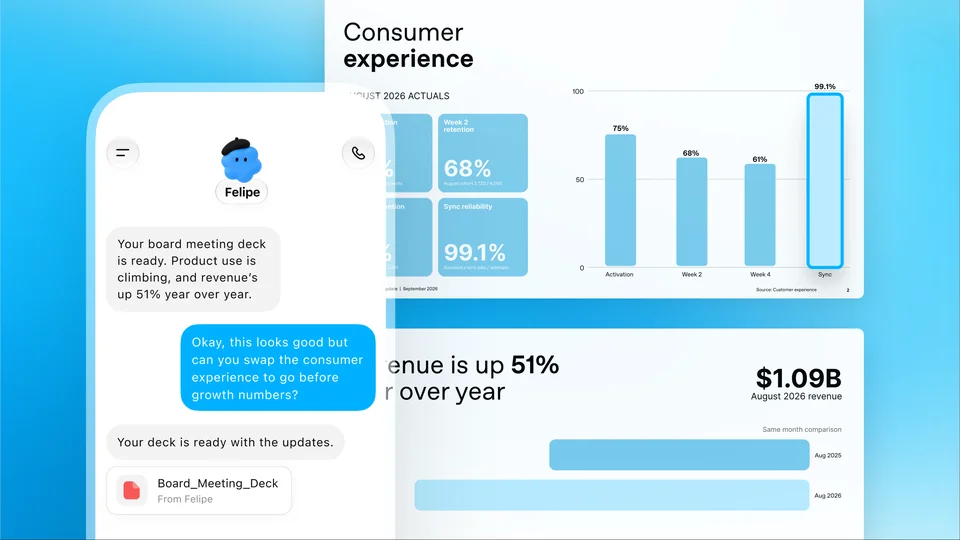
An investor update follows changes in product and revenue information. Official interface image.

Keep track and follow through.

An investor update follows changes in product and revenue information. Official interface image.

Grok Bot

by xAI

One person, an AI team, one PC.

Real Grok Bot interface footage from the official launch film. A chief of staff can coordinate specialist bots.

Cue

by Manus

Give the assistant room to work.

Official launch demonstration of an assistant with its own computer and tools.

Official demonstrations illustrate product behaviour; they do not establish typical success rates. Grok shows an excerpt from its official launch film.

It keeps working without another prompt.

Hand over a responsibility once. The assistant keeps the context and notices when something needs attention.

Illustrative Muse conversation
Muse
09:00

YOU · 09:00

K
Time passes

Scripted illustration, not a Muse recording. Sending replays the trip scenario; no account is connected or booking changed.

OpenClawOpen-source personal assistant

OpenClaw showed the capability early this year. The next wave centres on reliability.

Connected tools made personal agency tangible. The next wave must reduce how often the user has to reconnect, restart and repair.

Illustration of reported setup and execution problems
Travel email
Calendar
Browser
Check arrival → update transfer
trip-assistant / execution1 issues · user intervention needed
AUTH_SESSION_EXPIRED
browser.update_transfer → blocked

Expired access

The connection expires. The update cannot proceed.

Managed agent · the same task
issue_1 → awaiting recovery
checkpoint retained

Expired access

The task context is kept for recovery.

issue_2 → awaiting recovery
checkpoint retained

Execution failed · progress lost

The task context is kept for recovery.

issue_3 → awaiting recovery
checkpoint retained

Wrong information

The task context is kept for recovery.

Illustration built from reported user problems, not recorded product runs or a benchmark. Automatic recovery is the commercial test.

Customer inertia stops paying.

An action the customer already intended finally happens.

Illustrative · HK$100/month subscription

YOU

“I don't use this subscription. Cancel it.”

Without an assistant

Ongoing subscription charge

HK$100/month

“I'll cancel later.”

Renewal keeps charging.

Subscription remains active

Monthly renewals

HK$0 charged

With your assistant

Ongoing subscription charge

HK$100/month

Reading subscription
Submitting cancellation
Next debit: HK$100

Monthly renewals

HK$0 charged

The assistant handles the cancellation before renewal.

Illustration assumes confirmed cancellation before renewal. No refund or success rate is implied.

Illustrative refundable hotel booking

Your customer can still change their mind.

The customer intended to buy. A change in conditions can make a different decision worthwhile.

Watch the assistant act on a change the guest may never notice.

Without an assistant

HK$6,000

Original room cost

Booking left as it was

  1. Room booked

    A refundable stay is confirmed at HK$6,000.

  2. No price check

    The customer does not check again. The booking remains.

  3. No comparison

    No further comparison takes place.

  4. No change

    The original reservation stays in place.

  5. Original stay

    The guest checks in. Room revenue: HK$6,000.

With your assistant

HK$6,000

Original room cost

Saving the booking

  1. Book the room

    Saves the booking and cancellation deadline.

    Booking + terms saved
  2. The price changes

    Finds the same stay at a lower price.

  3. Check the conditions

    Checks room, dates, benefits and change costs.

  4. Decide whether to change

    Gets approval, then secures the revised booking.

  5. Confirm the outcome

    Checks the new booking and confirms the refund.

The guest still checked in.

The hotel receives HK$600 less for the stay and handles the booking change and refund.

Simulation assumes equivalent terms, availability, customer approval and a supported amendment or replacement before releasing the room.

Can the assistant transact and resolve with you?

Being recommended is the beginning. Your customer’s assistant also needs to act.

Personal agent · the full customer task

GEO · Find + Evaluate

Find

Accessible information that makes your business discoverable.

Discovery + consideration

Evaluate

Complete price, availability, eligibility and terms.

Discovery + consideration

Added scope · Transact + Resolve

Transact

A supported action and a confirmed result.

Authorised action → confirmed order

Resolve

Amendments, refund status and exception handling.

Amendment → refund confirmed

GEO is used here for discovery and consideration. The additional business requirement is supported execution and aftercare.

How much of your revenue comes from customers being too lazy to act?

And how much comes from a product or service they truly love?

Revenue you lose when the agent acts

Cancellations, price checks and eligible claims now get completed.

Agent checks and follows through

Subscriptions

An unused HK$100/month service

Until the agent acts · the money stays with you

Bookings

An equivalent room costs HK$600 less

Until the agent acts · the money stays with you

Claims and refunds

An unresolved eligible refund

Until the agent acts · the money stays with you

Money earned through customer choice

The assistant checks the value and brings the business the order.

Agent selects and acts
Your business

Useful product

Renews the service the customer uses

Checking the customer's requirements

Competitive offer

Books the offer that meets their needs

Checking the customer's requirements

Reliable aftercare

Chooses a provider that resolves problems

Checking the customer's requirements

The assistant completes cancellations and claims, and brings orders to services worth choosing.

Illustrative mechanisms, not revenue forecasts. Actions depend on terms, permission and supported access.

Who pays for the assistant’s work?

The customer may save money. The provider still has to pay for the work of checking, acting and following through.

Customer gets useful workProvider earns a fee

Subscription / bundle

The customer pays for ongoing access.

Recurring access must cover the cost of heavy users and exceptions.

Usage

The customer pays for the work used.

Uncertain bills can discourage open-ended delegation.

Transaction / outcome

A fee is tied to a purchase or an outcome.

The customer needs clarity about whose interests the assistant serves.

Does the value still reach the customer after the fee?

A HK$600 hotel saving is only worth paying for if the fee and the effort of supervising the assistant leave the customer better off.

Possible business models, not a description of current product pricing. A transaction fee may come from the customer or the business; the payer and incentives should be clear.