Preface Executive Briefing

Week of 12 October 2026

Your customer has an agent. Your business can have one, too.

Personal Agent Protocol proposes a common way for your customer’s agent and your company’s agent to connect.

Customer’s personal agent
Personal Agent Protocol
Your business’s company agent

You delegated the trip. Now the airline has an agent, too.

A personal agent carries out tasks for its owner, such as tracking a trip and responding when plans change. A cancelled flight brings the airline’s own agent into the task.

Last week: personal agents and ongoing delegation

The familiar instruction

“Keep my trip on track. Let me know if anything changes.”

New event: flight cancelled

Personal agent

Find a way to arrive tonight

Airline’s agent

Check the booking and available options

The enterprise can bring its information and actions into the customer’s task.

PAP gives the customer’s agent a recognised way in.

The same rebooking request. A more consistent way to establish identity, access and continuity.

In the news · 6 October 2026

The Next Web
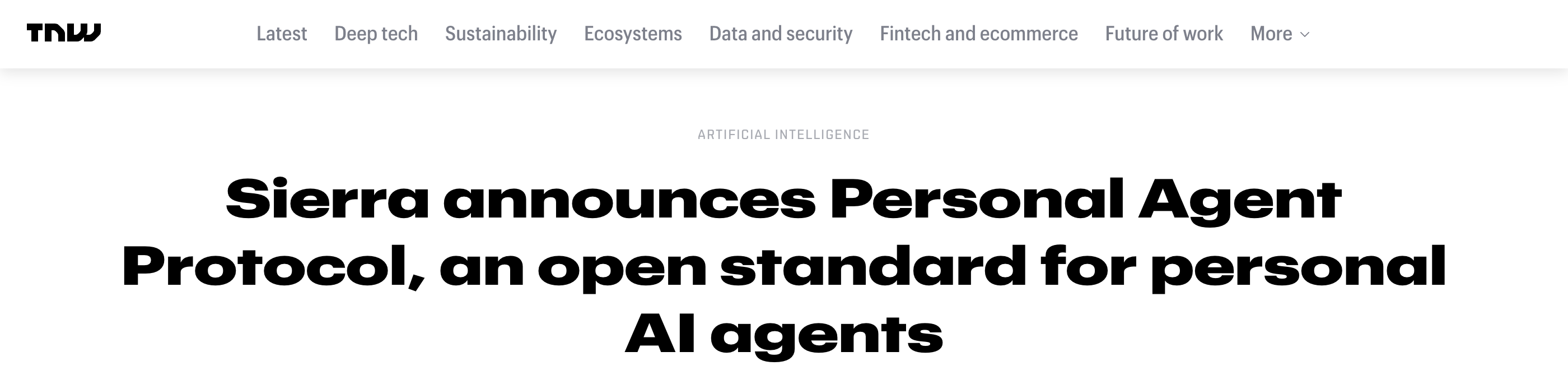
The Next Web headline: Sierra announces Personal Agent Protocol, an open standard for personal AI agents.

Actual headline capture. Sierra subsequently published the draft on 9 October.
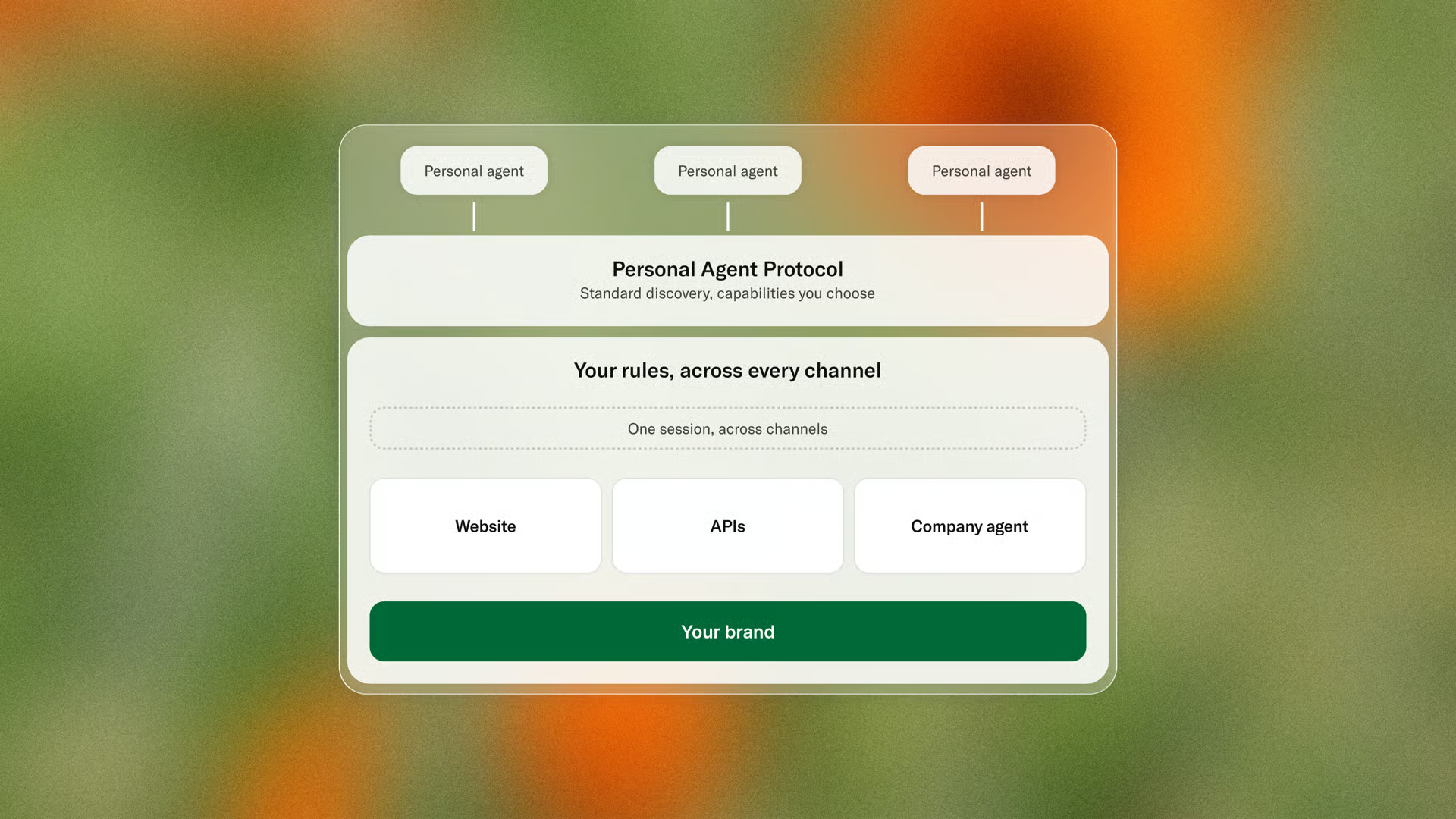
Official Sierra diagram: personal agents connect through PAP to a company’s website, APIs or company agent, under the company’s rules.
Sierra’s official diagram · draft published 9 October 2026. The company agent is one supported route.

Who is shaping it?

Meta + Sierra, with industry design partners
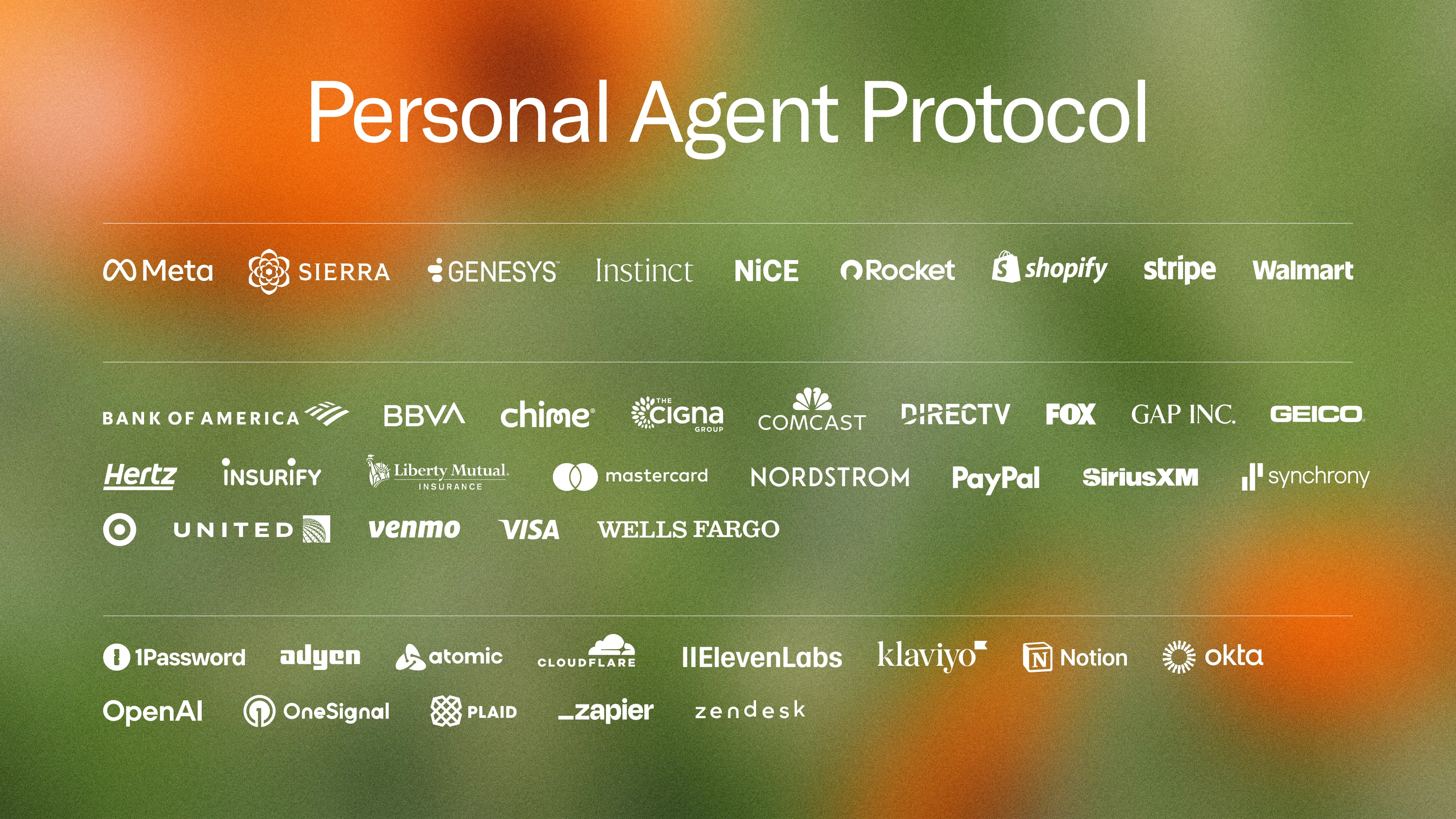
Sierra’s official PAP design-partner logos, including Stripe, Shopify, Rocket, Walmart, OpenAI and Visa.

Official design-partner graphic · 9 October 2026. Participation in design does not establish deployment.

Bret Taylor, photographed by Sierra

Sierra co-founder

Bret Taylor

Sierra builds agents for enterprises.

Chair, OpenAI Foundation board

Board context

What changes for the same customer request?

PAP proposes a shared entry point, customer-granted access and a session that carries across channels.

The same request

“Rebook my cancelled flight.”
Without a shared protocol · possible friction

The request can stall before service starts.

Personal agent
Airline’s agent
Possible interruptionsPossible friction
Entry blocked
Authority unclear
Context lost
Before rebooking can even begin.

Reconnect, confirm authority or repeat the brief.

Entry

Permission

Continuity

Possible friction before service
With PAP · proposed shared approach

A recognised request can move forward.

Personal agent
Airline’s agent
Shared hand-offReady
Route found
Access granted
Context retained
Ready for the airline’s reply.

The airline can now check routes and propose an offer.

Entry

Permission

Continuity

Ready to request rebooking options

Illustrative risks, not inevitable failures. Other integrations can handle these steps too. PAP proposes a common approach; it does not guarantee access, an available flight or a completed booking.

The airline’s agent has to build a workable offer.

Watch the request become a proposal, a customer decision and an issued ticket. The business checks change with the conversation.

The customer’s brief

“Get me there tonight. A connection is fine. Ask before paying extra.”

Personal agent ⇄ Airline’s agentAccess established via PAP
Airline’s current checkConfirm the completed result

The new ticket and approved charge are confirmed. The agreed itinerary has become an executed booking.

Personal agent → Airline

The flight was cancelled. Please find a replacement that arrives tonight. The customer has granted booking access.

Airline’s agent → Personal agent

I found the booking. Our next direct flight arrives tomorrow at 11:00. I’m checking connections for tonight.

Personal agent → Airline

Tomorrow would miss the customer’s meeting. A connection is acceptable; any extra payment needs their approval.

Airline’s agent → Personal agent

A connection arrives at 21:10 tonight. A seat is available and this route is permitted under our rebooking rules. It costs HK$400 extra.

Personal agent asks the customer

“The connection gets you there tonight for HK$400 extra. Shall I book it?”

Customer: “Yes, book that option.”
Personal agent → Airline

The customer approved the route and HK$400 charge. Please complete the rebooking.

Airline’s agent → Personal agent

Your new ticket is issued. Arrival: 21:10 tonight. The booking confirmation shows the approved charge.

Simulated airline workspace

Inside the airline’s workflow

DEMO SESSION · EP-01Complete
NeedOptionsRulesApprovalIssue
Booking confirmationMock UI
Read back the system result
Ticket issuedReplacement arrival21:10 tonight
Approved extra chargeHK$400
ConfirmationReturned to personal agent
The account changed. The task is complete.
Workflow activity · illustrative
  1. Replacement ticket issued
  2. Approved charge confirmed
  3. Receipt returned to personal agent

The company proposes. The customer approves. The issued ticket confirms execution.

Scripted teaching illustration. Times, price and rebooking rules are hypothetical; these checkpoints explain a business workflow, not Sierra’s internal model reasoning.

Your agent can retain a transaction and learn why an offer fails.

The exchange exposes what the customer needs, what the company can offer and whether the action actually happens.

Commercial outcome

Keep the booking by solving the problem.

The customer needs to arrive tonight. A permitted connection meets that need; the customer approves the cost.

Shared needSuitable offerIssued ticket
Retention depends on an offer the customer accepts.

Customer insight

Capture the constraint behind the request.

“Tomorrow misses the meeting” explains why an otherwise valid option fails. The company receives context the agent shares for this task.

Generic requestSpecific deadline
Even an incomplete transaction can reveal an unmet need.

Operating advantage

Connect the reply to company systems.

The agent needs current inventory, usable rules and booking actions. A convincing answer only creates value when the system completes it.

Seats + rulesConfirmed action
The business must equip its agent to deliver the offer.

Customer’s agent

Meet the deadline.

Ask before extra payment.

Company’s agent

Resolve within available options.

Manage recovery cost and retain the booking.

The agents can work towards different outcomes. Neither a company offer nor a protocol connection settles the customer’s choice.

If an offer fails, identify what needs to change.

No suitable route exists

Offer gap

Every permitted option arrives too late.

Review capacity, partner coverage or approval limits.

The option exists but is missed

Agent gap

The agent cannot find or present the suitable route.

Improve access, selection or the way options are explained.

Accepted, but no ticket issued

Execution gap

The customer agrees; the booking does not change.

Repair booking and confirmation.

Shared context → checked outcomes → better offers and operations.
Sierra describes tools for analysing conversations and improving agent knowledge. A single exchange gives a hypothesis; repeated, checked outcomes can reveal a pattern.

26%

of customers in Power’s recommendation flow

A missed recommendation can point to an agent problem.

Decagon reports that Power, a home-electronics retailer, found its agent could not identify a suitable product for 26% of customers. The team reprioritised engineering work and updated the agent logic.

Vendor-reported, September 2026. This concerns an existing enterprise-agent flow, not PAP adoption. It does not establish that Power lacked suitable products; the source does not give a sample size.

Decagon · Generative Analytics

The official examples show the proposed connection.

Our flight scene explains the business decisions. Sierra’s demonstration and PAP’s website provide the source evidence.

Rocket × Muse: from a request to mortgage pre-approval

Official summit demonstration linked by Sierra; the stage projection limits small-text readability. It does not establish general availability.

Watch the official demo
Official demonstration · Sierra Summit
01
Muse receives the task
02
Customer grants access
03
Rocket’s agent works with Muse

Sierra’s published flight example uses booking APIs. The two-agent airline conversation above is our teaching extension, not an observed airline deployment.

Get your business ready for customers’ agents.

01

Which task can your agent finish?

Start with one service request. Give your agent the information and system access to complete it. For rebooking: read the booking, find a route and issue the ticket.

02

What is each agent allowed to do?

Recognise the customer’s representative. Define permitted actions and when a person must approve. The agent can propose a route; the customer decides whether to pay extra.

03

What should change when a request fails?

Keep the reason a request failed. Check whether to fix the offer, the agent or execution. Was the route too late, was a suitable option missed, or was the agreed ticket never issued?